
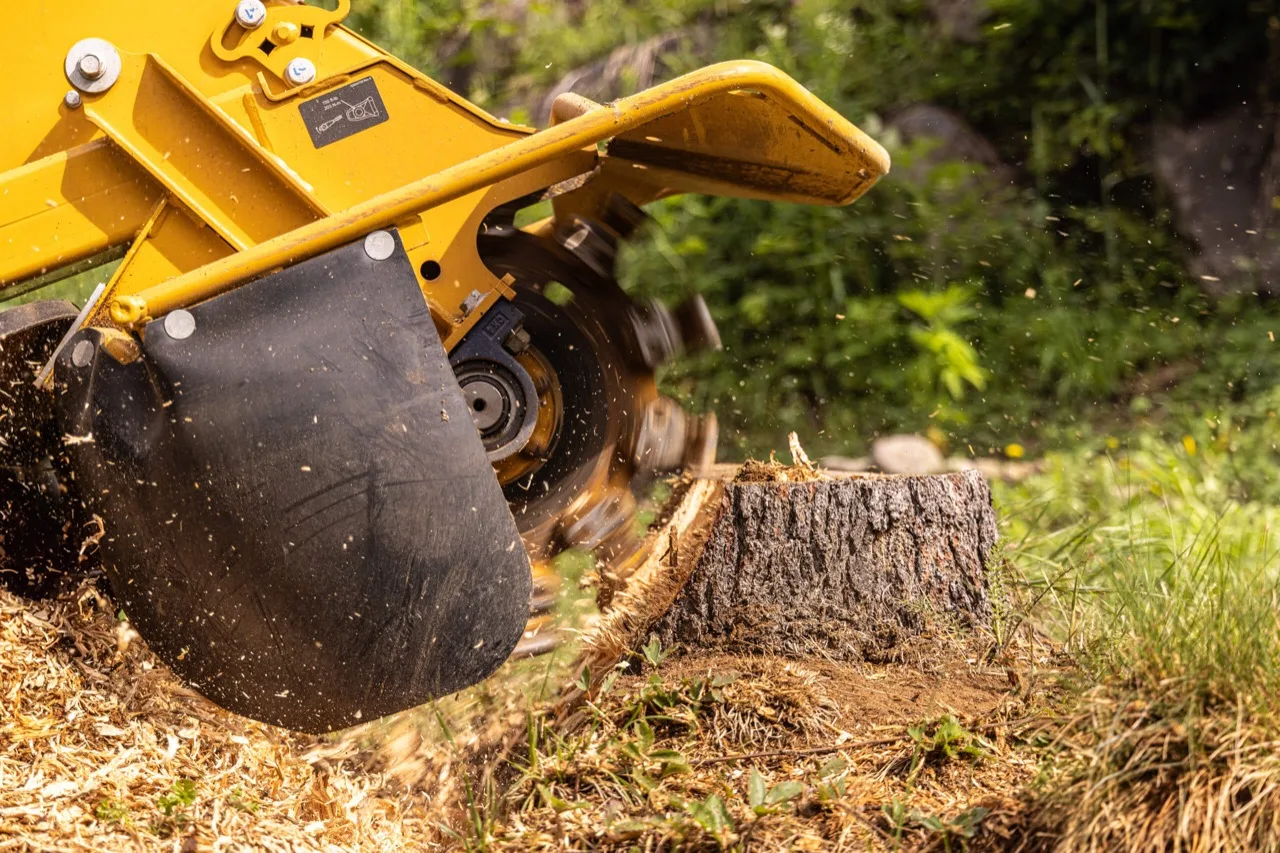
How much does stump grinding cost in Northeast Louisiana?
Expect about $2 to $5 per inch of stump diameter, with most single stumps landing between $150 and $450 and job minimums around $100 to $150. Grind a batch at once and each additional stump drops to roughly $40 to $75. Size, wood type, and access set the final number.
Those are market ranges, not a quote from us. Every stump grinding job gets priced off the actual stumps, and this guide walks through exactly how that pricing works so nothing on the invoice surprises you.
How companies price stump grinding
Three pricing methods cover almost every operator, and it helps to know which one you are hearing on the phone.
Per inch is the most common. The company measures each stump across its widest point at ground level and charges $2 to $5 for every inch. A 20 inch stump at $3 per inch is $60 of grinding, which sounds cheap until the minimum kicks in.
That minimum is the second piece. Getting a machine loaded, hauled to your property, unloaded, and set up costs the operator the same whether the job is one stump or thirty. Most companies cover that with a $100 to $150 first-stump or trip minimum. In-state published pricing tells the same story: one Shreveport operator lists most jobs at $100 to $400 per stump.
Hourly pricing shows up on big cleanups. Rates run about $100 to $200 an hour, and it usually beats per-inch pricing when a machine is going to sit on your property all day grinding dozens of stumps left from a land clearing job.
Stump grinding cost by size
| Stump size (widest point at the ground) | Typical all-in price, one stump | Each additional stump |
|---|---|---|
| Small, under 12 inches | $100–$260 | $40–$60 |
| Medium, 12–24 inches | $150–$440 | $50–$75 |
| Large, 24–36 inches | $250–$500 | $75–$150 |
| Extra large, 36 inches and up | $370–$800 | priced per stump |
The first-stump column runs higher than the per-inch math because it carries the trip minimum. That is also why the smartest move on most properties is grinding everything in one visit. Ten stumps ground separately could cost $1,500. Ground in one mobilization, the same ten might run $500 to $700.
What moves the price up or down
The wood itself matters. Oak, sweetgum, and hickory are dense, and grinding them is slow, so hardwood stumps often carry a $50 to $150 surcharge. Loblolly pine, the tree that covers timber country across North Louisiana, is soft by comparison and grinds fast. A yard full of pine stumps is cheaper than the same yard full of oak.
Access is the quiet cost driver. A stump in an open front yard is easy money. A stump behind a fence gate, on a slope, or in a tight bed between the house and the septic tank takes a smaller machine and more time, and operators add up to $50 an hour or a flat upcharge for it. Wet ground plays the same role out here. A grinder is a heavy machine, and soft ground after a string of Louisiana thunderstorms can push a job back a day or two, or push the operator to a tracked machine.
Surface roots add real money. If a big flare runs finger roots across the yard and you want them gone too, root grinding is usually billed hourly at $100 to $200.
Depth is the last lever. A standard grind goes 4 to 6 inches below grade. If the spot is going under a slab, a driveway, or a new tree, ask for 12 inches or more and expect to pay for the extra time.
The measurement that catches everyone
Companies measure a stump at ground level across its widest point, and that includes the root flare. The flare is the wide base where the trunk spreads into the dirt, and it is often much wider than the trunk was. A tree that was 15 inches through the trunk can leave a stump that taped out at 24 inches on the ground.
This is the number one reason a phone estimate comes in low. Measure at the dirt, count the flare, and mention any surface roots, and the price you hear on the phone will be a lot closer to the price on the invoice.
Chips, cleanup, and filling the hole
Grinding turns a stump into a surprisingly large pile of chips, commonly two to three times the volume of the stump you started with. The base price at most companies leaves that pile raked back into the hole. Hauling the chips off instead runs about $2 to $4 per inch or a $50 to $200 flat fee.
If you want grass there, plan on pulling most of the chips out, backfilling with topsoil mounded a little above grade, and seeding or sodding. Buried chips tie up nitrogen as they break down and the spot will settle for a year or two, so the mound is not optional if you want it level later. Our post on what happens after a stump is ground covers the hole, the roots, and the regrowth question in detail.
Renting a grinder vs hiring it out
Rental math looks tempting until you price the machine that actually does the job. The compact units at $60 to $90 a day only handle stumps under about 10 inches. The standard rental unit runs $200 to $400 a day, plus a trailer fee, a deposit, and your fuel, and it is a 25 horsepower machine built for the rental counter. Professional grinders run 50 to 120 horsepower.
For one small stump, renting can win. For anything bigger, a full day of wrestling a rental often adds up to what a pro would have charged to be done by lunch, with the chips raked and no trip to the equipment yard.
Grinding vs pulling the stump out
Grinding leaves the root system in the ground, where it slowly breaks down. Full removal digs the stump and root ball out with an excavator, and it costs two to five times as much, roughly $200 to $700 for an average stump against $100 to $400 to grind it. Removal earns that price only in specific cases, like building over the spot or replanting a tree in the same hole. We break the whole decision down in stump grinding vs stump removal.
One Louisiana-specific reason people clear stumps out entirely: termites. Dead stumps and buried wood are standing food for subterranean termites, including the Formosan termites established across much of Louisiana, and the state’s extension guidance is to get stumps and dead wood off the property rather than leave them rotting near a house. A ground-out stump with the chips handled is a much smaller invitation than a whole stump sitting there for a decade.
What a stump costs if you leave it
A stump does not just sit there politely. It sprouts, it hides in tall grass and bends mower blades, it feeds termites and fungus, and it makes a future buyer picture work. Most of the stumps we grind around Rayville, Monroe, and the rest of Northeast Louisiana come from trees that were cut years ago, and the price to finally deal with them is usually less than people expect once the trip is shared across every stump on the place.
FAQ
How much does it cost to grind one stump? Most single stumps run about $150 to $450 once a company mobilizes to your property, and national averages land near $250 to $300. The per-inch math is $2 to $5 per inch of diameter, but almost every operator carries a $100 to $150 minimum, so one small stump costs about the same as one medium stump.
Is it cheaper to grind or remove a stump? Grinding, by a wide margin. Grinding a 20 inch stump typically runs $100 to $400, while digging that same stump and its root ball out with an excavator runs roughly $370 to $675, plus backfill and lawn repair. Full removal only earns its price when you are building on the spot or replanting in the exact same hole.
How is a stump measured for pricing? At ground level, across the widest point, and that includes the root flare. A stump that was cut from a 15 inch trunk can measure 24 inches at the flare, which is why phone estimates from the trunk size come in low. Measure where the wood meets the dirt and tell the company about any surface roots.
Do multiple stumps cost less each? Yes. The trip, the trailer, and the setup cost the operator the same whether they grind one stump or twenty, so most companies price the first stump at their minimum and each additional stump at about $40 to $75. On a lot with a dozen stumps, the per-stump price often drops by half or more.
How deep does stump grinding go? The standard grind is 4 to 6 inches below grade, which is enough to cover the spot with soil and grow grass. If you plan to replant, pour concrete, or build over the spot, ask for a deeper grind of 12 inches or more. Deeper grinding costs more because it takes longer and works the machine harder.
Can I just rent a stump grinder instead? You can, but run the math first. Rental units big enough to matter cost about $200 to $400 a day plus a trailer, and the compact ones only handle stumps under about 10 inches. A professional machine is several times more powerful, and by the time you count the rental, fuel, and a weekend of work, hiring it out often costs about the same.
Does the type of tree change the price? Yes. Hardwoods like oak, sweetgum, and hickory are denser and slower to grind, and many companies add $50 to $150 per stump for them. Pine, which covers a lot of Northeast Louisiana, is softer and grinds faster, so pine stumps tend to sit at the low end of the range.
Get a straight price on your stumps
Count your stumps, tape the big ones at the dirt, and call (318) 235-7597 or ask for a free on-site estimate. Big Cypress Land & Game grinds stumps across Northeast Louisiana, and if the job is part of a bigger cleanup, our stump grinding crew can fold it into the clearing work so you pay for one mobilization instead of two.